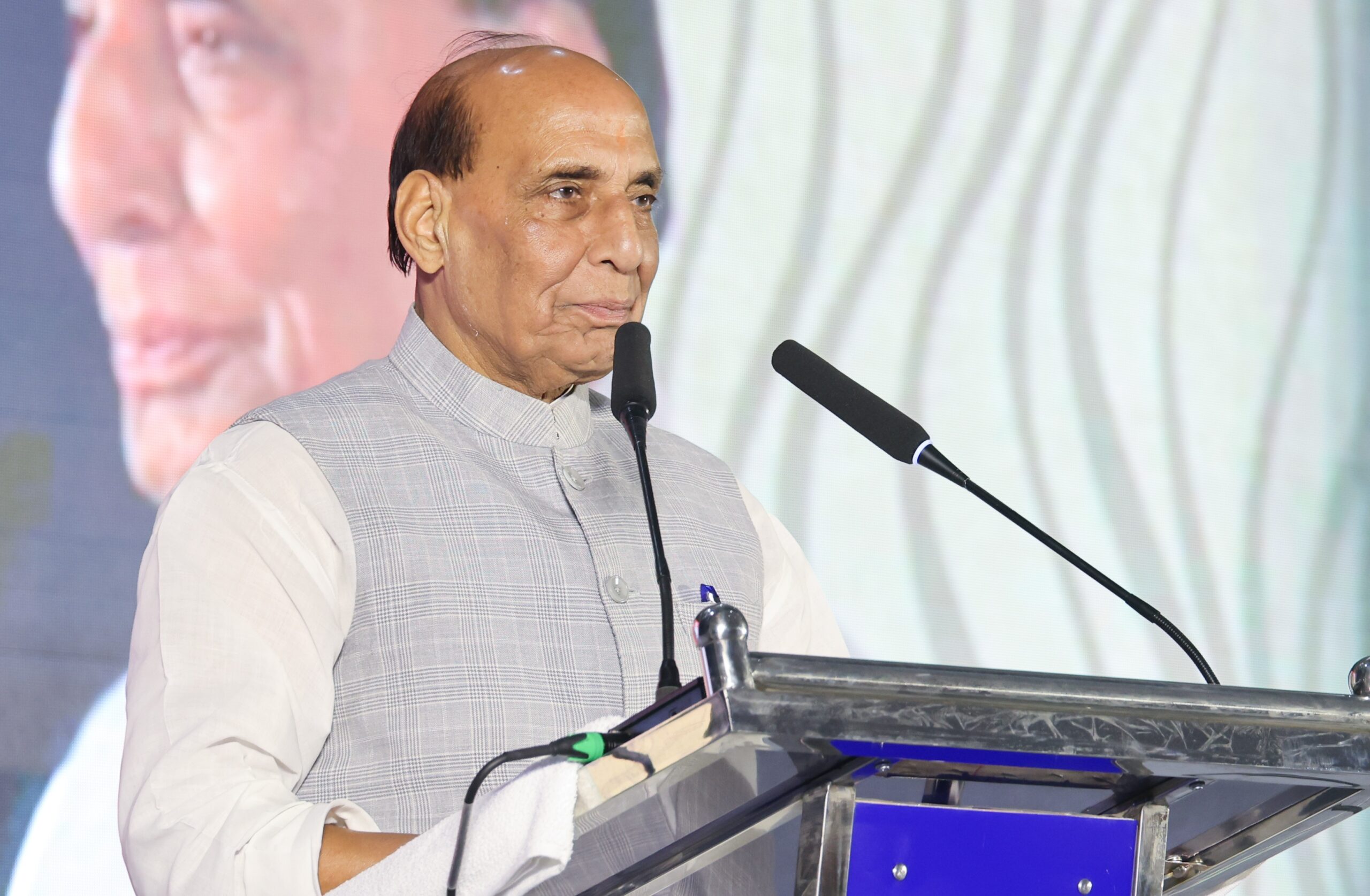
Ram Katha is universal and eternal, belonging to every place and every time: Raksha Mantri
Text of RM’s speech at the inaugural ceremony of ‘Ramayana- One Epic Many Stories: Ram Katha across Bharat & beyond’, a three-day conclave in Kochi, Keralam.
Keralthile ente priyappetta sahodari sahodaranmare, ellavarkkum ente namaskaram. (Dear brothers and sisters of Kerala, my warm greetings to all of you.”
First and foremost, I would like to thank Shri M. Radhakrishnan, Managing Director of Janmabhumi Daily; Shri K. N. R. Namboodiri, Editor; and Shri Kaithapram Namboodiri, Chairman of the One Epic, Many Stories Organising Committee, for inviting me to this Conclave.
A few years ago, I inaugurated the Kollam edition of Janmabhumi. And today, it gives me immense pleasure to be here once again at a Janmabhumi event.
Friends,
It is always a great pleasure and a privilege for me to be in Keralam.
The natural beauty of Keralam brings a deep sense of peace and joy to the soul. It is no wonder that Kerala is known as “God’s Own Country.” And, whenever I come here, the warmth and affection of its people touch my heart.
Keralam is the land of Jagadguru Adi Shankaracharya Ji. It is the land of Sree Narayana Guru Ji, who gave the message of social harmony and equality. It is also the land of Mahatma Ayyankali. This reflects the immense contribution that Keralam and its people have made to India’s cultural heritage and its developmental journey.
Friends
As the Defence Minister, I am often invited by media organisations to share my views on matters relating to defence and national security.
But I am particularly pleased that Janmabhumi has invited me to speak on a subject as profound as the Ram Katha. Such conversations are important because they help our younger generation understand the richness of our heritage, draw strength from it, and carry it forward.
Friends,
Journalism is rightly called the fourth pillar of democracy. Because in a democracy, an independent and impartial press is one of the strongest instruments for ensuring accountability. The role of the media is not merely to report the news. It is also to ask difficult questions, bring the truth before the people, and hold those in power accountable.
I believe that the role of the print media is somewhat more important. Electronic media is often in a race to break the news first, while social media is in a race to make every story trend.
But print media has greater sobriety. No matter how breaking the news may be, a newspaper reaches its readers only in the morning. This gives more time to check and verify every piece of information. This makes print media relatively more reliable.
Friends,
Journalism has always played a vital role in awakening public consciousness and giving voice to the people. During the freedom struggle, for instance, Bal Gangadhar Tilak used newspapers such as The Kesari and The Mahratta not only to criticise the unjust policies of British rule, but also to inspire and mobilise people to join the freedom struggle.
Journalism continued to play a very important role even after independence. During the Emergency in 1975, for instance, many journalists and publications fought to protect democracy. Despite censorship, they found creative ways to keep the people informed and aware, and to protect the Constitution.
The journey of Janmabhumi itself is an example of this. During the Emergency, the Managing Director and Chief Editor of Janmabhumi were arrested. But the journey of Janmabhumi continued. With a commitment to “Social Reformation” and “National Reconstruction,” Janmabhumi continued to carry forward its journalistic mission.
I believe the greatest strength of Janmabhumi is its readers, who have stood by it through every circumstance, continued to place their trust in it, and have given it the strength to keep moving forward.
On this occasion, I congratulate the journalists, editors, writers, and staff associated with Janmabhumi, as well as its readers, on this successful journey.
Friends,
The role of Janmabhumi has never been limited to that of a newspaper. It has consistently provided a platform for dialogue on subjects that are essential to understanding India’s civilisation, culture, heritage, and knowledge traditions. In this spirit, this conclave organised by Janmabhumi on the theme, “One Epic, Many Stories – Rama Katha Across Bharat and Beyond,” is truly commendable.
Ladies and Gentleman
Keralam is home to several sacred places associated with the Ramayana. It is believed that at Chadayamangalam in Kollam, the valiant Jatayu fought Ravana. This is why the place was once known as Jatayu-Mangalam. Similarly, it is believed that Sita Mata returned to the earth at Pulpally.
Keralam also has a special tradition of undertaking the ‘Nalambalam’ pilgrimage. The Thriprayar Temple is renowned for this pilgrimage. Before the ‘Pran Pratishtha’ of Bhagwan Ram in Ayodhya, Prime Minister Shri Narendra Modi ji also visited the Thriprayar Temple.
Mahakavi Ezhuthachan ji, the author of Adhyatma Ramayanam Kilippattu, made a great contribution in taking the Ram Katha to every household in Keralam. I pay my respects to him.
Today, I would also like to pay homage to the late P. Parameswaran Ji and the late Madhav Ji, who further strengthened the tradition of the Ram Katha through unique initiatives such as ‘Ramayan Masam’ during the month of Karkidakam.
Ladies and Gentlemen,
Goswami Tulsidas ji has beautifully expressed this thought: “Hari anant, Hari katha ananta; kahahin sunahin bahubidhi sab santa.” In other words, the divine is infinite, and so is the story of the divine. There are, therefore, countless ways of telling and listening to it. The story of Bhagwan Ram offers perhaps the clearest illustration of this truth.
It is said, “Ramte kane-kane iti Ramah” — that which is present in every particle is Ram. Just as Bhagwan Ram is present in every particle, the Ram Katha, too, is told and heard across Bharat and around the world.
In Northern India, there is a very old tradition of staging the Ram Lila. In Uttar Pradesh, Ram Lila is performed across the state every year on the occasion of Dussehra. Uttarakhand has traditions such as ‘Ramvarta’ and the ‘Rammān Mahotsav’. Kashmir, too, has its own tradition of the Ram Katha in the form of ‘Ramavatar Charit’.
In eastern India, the ‘Bisi Ram Lila’, based on ‘Vichitra Ramayana’ written by Shri Vishwanath Khuntia, is very well known in Odisha. In West Bengal, the ‘Krittivasi Ramayana’ holds a highly respected place, and there is also a tradition of retelling the Ram Katha through ‘Jatra’ and ‘Putul Nach’. In western India, Gujarat has the ‘Girdhar Ramayana’, while Maharashtra has the ‘Bhavartha Ramayana’.
In North-East India, Assam is known for the ‘Saptakanda Ramayana’ of great poet Madhava Kandali ji and the play ‘Ram-Vijay’ of the saint-poet Shankardeva ji. In Manipur, the Ram Katha has traditionally been narrated through the ‘Wari-Leeba’ storytelling tradition. The tribal communities of Bharat, too, have their own distinct versions of the Ram Katha. In Southern India, the ‘Kamban Ramayana’ in Tamil and the ‘Torave Ramayana’ in Kannada are particularly well known.
The Ram Katha, therefore, transcends all regional and linguistic boundaries. It lives in the villages of Bharat as much as in its cities. It is found in our temples and in our folk songs, in theatre and dance, and in our puppetry traditions.
Friends,
The journey of the Ram Katha did not stop with Bharat. It travelled across entire Asia, where it continues to be told and cherished. A scholar once observed that if Asia has a story of its own, it is the Ram Katha.
In Nepal, the Ramayana composed by Bhanubhakta is regarded as the first and most important epic in the Nepali language. In the folk traditions of Sri Lanka as well, stories associated with Shri Ram continue to be shared through the generations.
I recently visited Sri Lanka, where I had the privilege of visiting the Sita Amman Temple. It is believed to be the place where Mata Sita was held captive by Ravana.
If we look at East Asia, the Ram Katha finds mention in the twelfth-century Japanese text Hōbutsushū. In China and Mongolia, too, there is evidence of stories and traditions associated with Bhagwan Ram and Hanuman ji. In Central Asia, the Khotan Ramayana is particularly well known.
In Southeast Asia, the reach of the Ram Katha is even more remarkable. In Malaysia, there is the ‘Hikayat Seri Rama’; in Laos, the ‘Phra Lak Phra Ram’; in Cambodia, the ‘Reamker’; and in Thailand, the ‘Ramakien’ is widely popular. Thailand also has a rich tradition of ‘Khon Ram Lila’ performances. Indonesia, where nearly 90 percent of the population is Muslim, also has a long tradition of the Ram Katha, popularly known as the ‘Ramayana Kakawin’.
Friends,
It has been truly said of the Ramayana that no other scripture has brought greater worldly and spiritual welfare to humankind. Ancient in its origins, yet ever new in its relevance; deeply human in its essence, yet divine in its spirit.
The power of the Ram Katha is such that no one can hear it without being captivated by it. Let me give you an example. Father Camille Bulcke was a missionary who came to Bharat from Belgium. After coming to Bharat, he became a devoted admirer of Tulsidas ji and Valmiki ji. Once, Father Camille Bulcke asked a Muslim teacher from Indonesia, “Why do you read the Ramayana?” He replied, “To become a better human being.” In that sense, the Ram Katha is not merely the story of Hindustan, but of humanity.
Ladies and Gentlemen,
According to our traditions and Puranas, Keralam is believed to have been reclaimed from the sea by Bhagwan Parshuram. This is why, in the Puranas, this land is also known as ‘Parshuram Kshetra’. Rishi Parshuram and Bhagwan Shri Ram are both incarnations of Bhagwan Vishnu. In this way, Keralam has a deep and enduring connection with Bhagwan Ram. Today in Keralam, families come together in the evening, light the Nilavilakku, and chant the name of Bhagwan Ram.
But there are also some people in Keralam who have opposed the Nilavilakku. People with a similar mindset had also opposed the ‘Ramayan Masam’ initiative and the temple of Bhagwan Ram in Ayodhya.
Such people fail to understand that Lord Ram and the Ram Katha have never been confined to any one religion or community. Bhagwan Ram is at the very heart of Indian culture. The story of Bhagwan Ram has been central to the evolution of Indian civilisation. Bhagwan Ram is an inseparable part of who we are.
For instance, in Mewat, Rajasthan, there has been a tradition of Muslim Jogis singing the Ram Katha. Muslim Manganiyar artists, too, sing bhajans and songs related to the Ram Katha. In Bengal, Muslim Patua artists have traditionally travelled from village to village, narrating the Ram Katha. The ‘Mappila Ramayanam’ of Keralam is also a beautiful example of this tradition.
Amir Khusrau described the qualities of Bhagwan Ram as ‘Amal Paiham’—worthy of being embraced by all. Iqbal, too, referred to Bhagwan Shri Ramchandra ji as ‘Imam-e-Hind’.
Friends,
The Ram Katha has transcended not only the boundaries of religion, language, and region, but also those of time.
Several names, associated with the Ram Katha, are also found in Vedic literature. The Ram Katha is also described at several places in the Mahabharata. In the Buddhist tradition, there is a Jataka tale in which Bhagwan Buddha himself says that he is Ram. Similarly, the Ram Katha holds an important place in the Jain tradition as well. In this tradition, ‘Ramavatar’, composed by the Sikh Guru, Guru Shri Gobind Singh ji, is also of great significance.
The Ram Katha, therefore, does not belong to any one age, faith, language, or land. It is universal and eternal—belonging to every place and every time. We greet each other with ‘Ram-Ram’, and even when mortal remains are taken for last rites, the name of Ram is chanted. From the first breath to the last, Ram remains woven into every moment of our lives.
Ladies and Gentlemen,
Bhagwan Ram is revered as Maryada Purushottam—the noblest among men. It is said that nine virtues are essential to attain this ideal of Purushottam, and all these virtues were embodied in Bhagwan Ram. If a nation draws inspiration from these virtues and moves forward, nothing can prevent it from becoming developed and great.
The first of these virtues is jijivisha—the courage to struggle and persevere. Whatever the circumstances, we must move forward with integrity and discipline towards the fulfilment of our resolve.
Before 2014, there was a sense of frustration and despair in India. Corruption and misgovernance had weakened the morale of ordinary people. India was being counted among the “Fragile Five” economies. It was in these circumstances that our government was formed under the leadership of Prime Minister Modi ji. We did not allow ourselves to be daunted by adversity. Instead, we prepared a roadmap to tackle it. Over the past 12 years, the world has faced a pandemic like COVID-19 and witnessed several wars, which have had a profound impact on the global economy.
But we turned every adversity into an opportunity and kept moving forward. As a result, India today is no longer counted among the Fragile Five, but among the Top Five Economies. Despite the many global challenges, we are moving steadily on the path towards becoming a self-reliant and developed nation.
The second virtue is the protection and security of our citizens from evil forces. Today, India is moving forward with this very principle. During Operation Sindoor, the world saw that we are now willing to cross any border to eliminate those who threaten us. Investment in border infrastructure has increased by as much as 400 percent. Today, Naxalism has also been brought to an end.
The third virtue is to illuminate—to spread light. Today, through its efforts, India has become a source of hope for the entire world. For instance, India has achieved several of the targets it had set in the fight against climate change ahead of schedule. We not only provided free vaccines to our entire population, but also sent more than 300 million vaccines to 100 countries.
The fourth virtue is Purushartha—the determination to work tirelessly towards one’s goal, to move forward with courage, and to achieve success through one’s own efforts. Our greatest strength is our youth. Today, the youth of our country are building startups, creating unicorn companies, developing drones, building hydrogen trains, and making rockets and satellites. In other words, through their Purushartha, they are leaving no stone unturned in taking India towards becoming a developed nation.
The fifth virtue is compassion. Guided by this value, we are working to improve the lives of our citizens. For instance, over the past 10 to 12 years, India has lifted more than 250 million people out of poverty.
The sixth virtue is ‘Prachodana’—the power to inspire and become a source of inspiration for the future. Whether it is the success of India’s democracy or the success of its welfare schemes, India today serves as a source of inspiration for the world. For instance, UPI is today the world’s largest real-time payment system, and more than eleven countries have adopted it.
The seventh virtue is ‘Sabalata’ or strength and capability. Today, India is moving forward with a growth rate of 7.8 percent. We have grown stronger not only economically, but also in terms of strategic capabilities. Our indigenous defence production has now reached nearly ₹1.8 lakh crore. We are exporting defence equipment worth around ₹40,000 crore to more than 100 countries.
The eighth is Bhūma—the expansion of one’s glory. Today, India has emerged as a civilizational leader. Today, the world celebrates International Yoga Day. Think about it: India is now providing leadership to the world through initiatives such as the International Solar Alliance and the Global Biofuels Alliance.
The ninth is Aishwarya—prosperity. Our government has been working to make everyone prosperous. Development today has become more inclusive. Look at the figures for schemes such as PM SHRI, Ayushman Bharat, Lakhpati Didi, Pradhan Mantri Awas Yojana, Jal Jeevan Mission, and Ujjwala Yojana. You will find that people’s lives have improved and have become more prosperous. In other words, India today is moving forward by making the virtues of Bhagwan Ram its ideal. And these nine virtues will make India both a great and a developed nation.
Friends,
India gained independence from colonial rule in 1947. We became politically free, but our cultural and civilizational renaissance remained incomplete. This was because some of those at the helm at the time looked down upon Indian culture. Imagine this: there was opposition to the then President, Dr. Rajendra Prasad ji, attending the inauguration of the reconstructed Somnath Temple.
When India gained independence, it was said that the soul of a nation, long suppressed, would finally find utterance. Today, I ask: who could better represent the soul of India than Shri Ram? No one.
Then why did it take seven decades after independence for the temple of Bhagwan Shri Ram to be built? Why was the very existence of Bhagwan Ram questioned? This happened because of the politics of appeasement. It happened because of a flawed Western secularism imposed upon India. This idea views ‘Dharm’ as being opposed to the state and politics. Such a view is not in keeping with the Indian way of life.
Friends,
India is the only land where every faith has found a home, and no faith has been persecuted. “Sarva Dharma Samabhava,” or equal respect for all faiths, has always been at the heart of our civilizational ethos. This spirit comes from our faith in the values of Bhagwan Ram. And yet, because of Western secularism, our Dharma was made to appear as communalism, tradition as backwardness, belief as fanaticism, and faith as superstition.
This was never the vision of India’s freedom fighters. Shri K. M. Munshi ji believed that a secular state does not mean a state opposed to God. Similarly, Shri H. V. Kamath, a member of the Constituent Assembly, said that a secular state is neither godless, irreligious, nor opposed to religion.
Friends,
Today, under the leadership of Prime Minister Shri Narendra Modi ji, India is witnessing a cultural and civilizational renaissance. Today, we are shedding the colonial mindset.
We must also re-establish the Indian conception of secularism—one that respects the harmony between faith and modernity, and embraces the broader understanding of Dharma that Mahatma Gandhi also envisioned. Mahatma Gandhi made it clear that politics without religion cannot even be conceived.
Friends,
We must make our youth aware of our culture. Because until they know and understand it, conspiracies to divide India will continue to be hatched. Our revered figures and heroes will continue to be denied their rightful place by historians. And our goal of regaining India’s pride in the world will remain unfulfilled.
I believe that when our youth learn about our culture, our national consciousness will grow stronger. India will rise economically, socially, and politically. And initiatives like “One Epic, Many Stories – Rama Katha Across Bharat and Beyond” will play an important role in this endeavour.
With this hope and prayer, I bring my remarks to a close. Jai Hind! Jai Bharat! Jai Shri Ram!