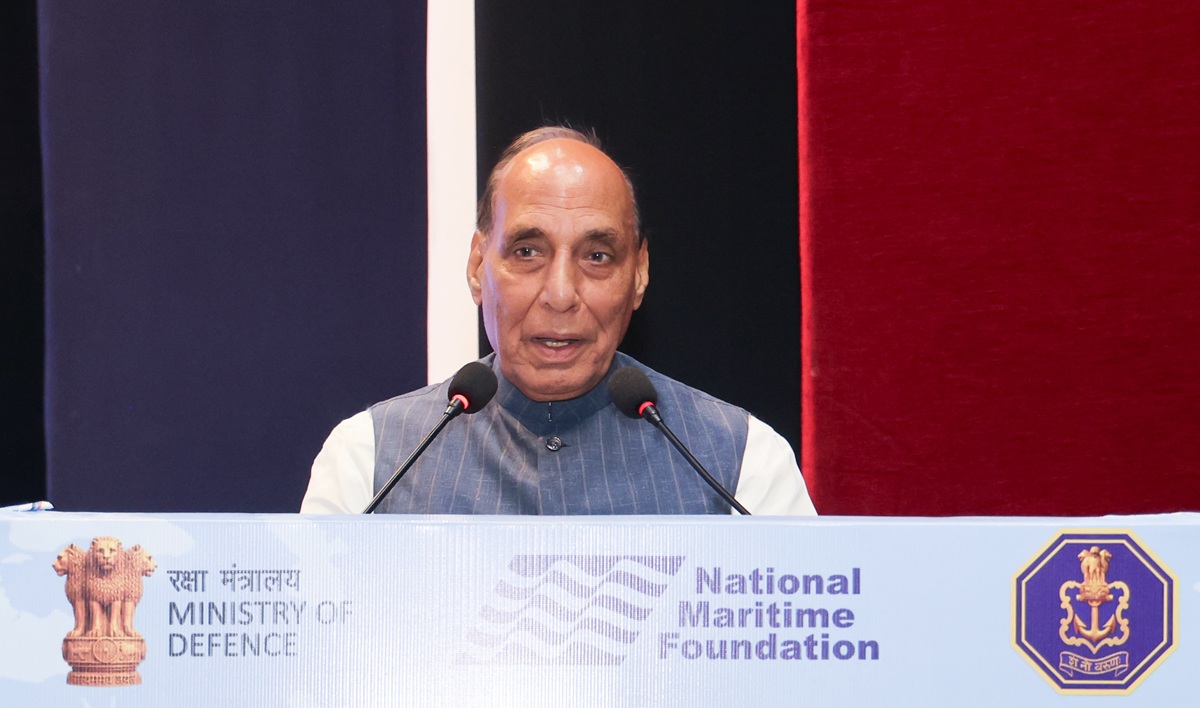
India stands for a free, open & rules-based world order: Raksha Mantri
Text of RM’s speech at the Commemorative Session of the Indo-Pacific Regional Dialogue #IPRD2026 in New Delhi.
I am truly pleased to be here today in this assembly of policymakers, maritime practitioners, scientists, technologists and scholars from India and across the globe. Your participation makes this key regional dialogue deeply meaningful.
I believe, many of you might have participated in the previous editions of this dialogue. I have also addressed this gathering on several past occasions. This year, however, we gather amidst severe disruptions in the global maritime security environment. That global turbulence gives me an opportunity to address you today with a sense of urgency.
Friends, all of us know that this forum has evolved into a vital institution. Over successive editions, it has examined the critical challenges and opportunities confronting our maritime region. I compliment the Indian Navy and the National Maritime Foundation for bringing together such a diverse community and organising this conference to discuss critical maritime security issues.
Friends, Today, I wish to reflect upon a fundamental question. What makes the maritime domain so important to the destiny of nations ?
We often discuss ships, submarines, aircraft, ports, technologies and maritime infrastructure. We discuss naval capabilities and emerging threats. These discussions are necessary. But beneath all these developments lies a much more fundamental reality – The oceans themselves. Their importance has endured through centuries. Technologies have changed. The nature of warfare has changed. The scale of global commerce has changed. Yet, the fundamental importance of the oceans has not diminished. In fact, it has only increased.
Friends, let us look back at the long journey of human civilization. In ancient times, humanity did not possess the engineering capability to cross the open seas. Back then, our ancestors naturally viewed these vast waters as a formidable barrier between civilizations. Later, human developed the capacity to navigate across the seas. From then onwards, we have stopped viewing the oceans as barriers. Instead, we now see them as a grand bridge between nations. They became a living connection between civilizations and countries. They served as a rich source of livelihood and a carrier of ideas from one shore to another.
For India, the oceans have never been distant or alien spaces. For centuries, Indian mariners crossed these waters carrying not only goods, but also knowledge, culture, and human relationships. This is the primary reason why, India has always contributed responsibly to a free, open, and rules based international order.
Friends, science reminds us that water is where life itself began. Initially, life existed only within the depths of the oceans. Over ages, that life migrated onto dry land, across the plains, and up onto the highest mountains. Every form of life we see on land today evolved from the ancient seas. Yet even after millions of years of evolution on land, humanity cannot survive without the oceans. Our biological origin has simply evolved into an existential economic dependency.
Friends, consider the reality of our modern world. Today, a common citizen living in an inland town may never have seen an ocean or a sea. That citizen cannot easily imagine how deeply their daily life depends upon the waters. Yet the experience of recent years has reminded us of a fundamental truth. While modern globalization may appear digital, financial, and instantaneous, its physical foundations remain profoundly maritime.
Be it global trade, the internet, or energy, modern human life is tied to the sea today more than ever. Energy, food, fertilizers, raw materials, and manufactured goods move through ports and shipping lanes. Data may travel across the world in milli-seconds. Yet over ninety five percent of that digital traffic travels through fiber optic cables laid across the ocean floors. Our factories, farms, and cities continue to depend upon physical flows of commodities across the water. Our seas also support coastal fisheries, regulate our planetary climate, and hold vital resources for future industries.
Everyone in the international community understands these universal dependencies. Despite this knowledge, certain actors and nations seek to exploit the criticality of the oceans for narrow unilateral gain. By pursuing selfish leverage, they seek to deny the shared benefits of the seas to humankind. Today, the global maritime security environment is strained by deliberate trade disruptions. We see blatant challenges to the freedom of navigation and the weaponization of narrow maritime passages. This growing instability in the maritime domain casts a long shadow over the broader international order.
Friends, we must therefore ask ourselves a difficult question. Can an inter-connected world remain secure if its critical connections are vulnerable? The answer lies in building resilience. We cannot respond to every disruption by withdrawing from globalization. Nor should we seek to close the maritime spaces that have enabled human progress.
Our objective must be to make inter-dependence more secure. This requires diversification of supply chains. It requires reliable maritime infrastructure. It requires better information and awareness. It requires cooperation among nations. And it requires the ability to anticipate disruptions, to ward them off and recover from them. It also requires us to recognize that maritime security today extends far beyond the traditional understanding of naval security.
The security of shipping lanes remains essential. But so does the security of ports, undersea cables, offshore energy infrastructure and other critical maritime assets. The ability to understand what is happening across our maritime spaces has become equally important.
The threats may emerge from conventional military activities. They may also arise from non-traditional challenges, including piracy, trafficking, illegal fishing, cyber-attacks and natural disasters. Our understanding of maritime security must therefore evolve with the changing nature of the maritime domain.
Ladies and Gentlemen, this brings me to the role of science and technology. The theme of this year’s Dialogue which is “Science, Technology and Academic Cooperation within Indo-Pacific” is particularly relevant in this context. We are witnessing a remarkable transformation in human capability. Artificial intelligence is changing the way data is processed. Autonomous systems are expanding the possibilities of surveillance and operations. New sensors are improving our ability to observe the oceans. Advances in materials, biotechnology and data analytics are opening new avenues for research and application. These developments have enormous implications for maritime security and economic activity. But technology, by itself, is not the answer. The more important question is how we use technology to address real challenges.
Can we use artificial intelligence to improve maritime awareness and decision making?
Can autonomous systems help us monitor larger maritime areas?
Can ocean science improve our understanding of climate change and marine ecosystems?
Can advanced technologies help protect undersea infrastructure?
Can innovation make ports more efficient, shipping cleaner and maritime operations safer?
These are not merely questions for scientists and technologists. They are questions of national security, economic development and human welfare.
Friends, I would also like to emphasize one important point. Technology must not become another source of in-equality among nations. The Indo-Pacific includes countries with very different levels of technological and economic capability. Some possess advanced research infrastructure. Others are still developing the institutional and human resources required to participate fully in this transformation. If technological progress benefits only a limited number of countries, we will not achieve the collective resilience that our region requires.
Friends, we must therefore promote cooperation in research, education, innovation and capacity building. A stronger scientific capability in one country can contribute to the security and prosperity of the entire region. This is particularly important for smaller maritime nations and developing countries. The most useful technology is not necessarily the most expensive or sophisticated technology. It is the technology that solves a real problem. It is affordable. It can be maintained. It can be adapted to local requirements. And it produces tangible benefits for people. We must measure innovation not only by what it can achieve, but also by the problems it can solve.
Friends, for India, these developments have a special significance. As we move towards Viksit Bharat 2047, the maritime domain will play an important role in our national transformation. Our ambitions are not limited to expanding trade or strengthening naval capabilities. We seek to develop a comprehensive maritime ecosystem. We are investing in port infrastructure and connectivity. Through Sagarmala, we are pursuing port led development. We are working towards more efficient and sustainable ports. We are promoting coastal economic activity and strengthening the maritime industrial base. Our national blueprint, the Maritime Amrit Kaal Vision 2047 provides a broader direction for this transformation. It places emphasis on technology, innovation, research, education and skills. Our vision of the Blue Economy also reflects an important understanding.
Friends, economic development and environmental responsibility must progress together. The oceans cannot be treated as an unlimited source of resources. Their ecosystems must be protected. Their resources must be used responsibly. The interests of coastal communities must remain central to our development efforts. National prosperity and ecological responsibility are not competing objectives. They must reinforce each other.
At the same time, our maritime responsibilities extend beyond our national coastline. India has consistently supported an open, inclusive and rules based maritime order. Our approach is reflected in MAHASAGAR, which stands for “Mutual and Holistic Advancement for Security and Growth Across Regions”. It recognizes that the security and prosperity of nations are inter-connected. It also recognizes that the maritime future of the Indo Pacific cannot be shaped by any single country acting alone.
The Indo Pacific Oceans Initiative, announced by our Prime Minister in 2019, provides a practical framework for advancing maritime cooperation across seven inter-connected areas. The IPRD contributes to this larger effort. It brings together different communities to examine specific challenges and identify practical solutions. This connection between national priorities, regional cooperation and actionable outcomes is important.
Friends, while these frameworks offer a clear path forward, we must acknowledge that such regional cooperation does not exist in a vacuum. The ideas generated in forums like the IPRD only hold value when they are actively translated into concrete initiatives. We stand at a crucial juncture where our collaborative aspirations must urgently evolve into joint technological and operational endeavours.
Therefore, I urge the distinguished participants gathered here to make this Dialogue an opportunity for practical action. Let us move beyond identifying challenges. Let us identify areas where our institutions can work together. Let us build stronger scientific networks. Let us promote joint research. Let us encourage exchanges between universities and maritime institutions. Let us explore affordable technological solutions for common challenges. Most importantly, let us ensure that the ideas emerging from this Dialogue do not remain confined to conference halls. They must translate into partnerships, projects and measurable outcomes.
The future of the Indo Pacific will not be shaped by technology alone. It will be shaped by the wisdom with which we use that technology, the partnerships we build and the confidence we create among nations. India stands ready to contribute to this collective endeavour.
I compliment the Indian Navy and the National Maritime Foundation for organizing this important Dialogue. I wish all distinguished participants fruitful discussions and meaningful deliberations.
Let us move from shared challenges to shared understanding. From shared understanding to shared knowledge. And from shared knowledge to shared resilience and shared prosperity.
Jai Hind!