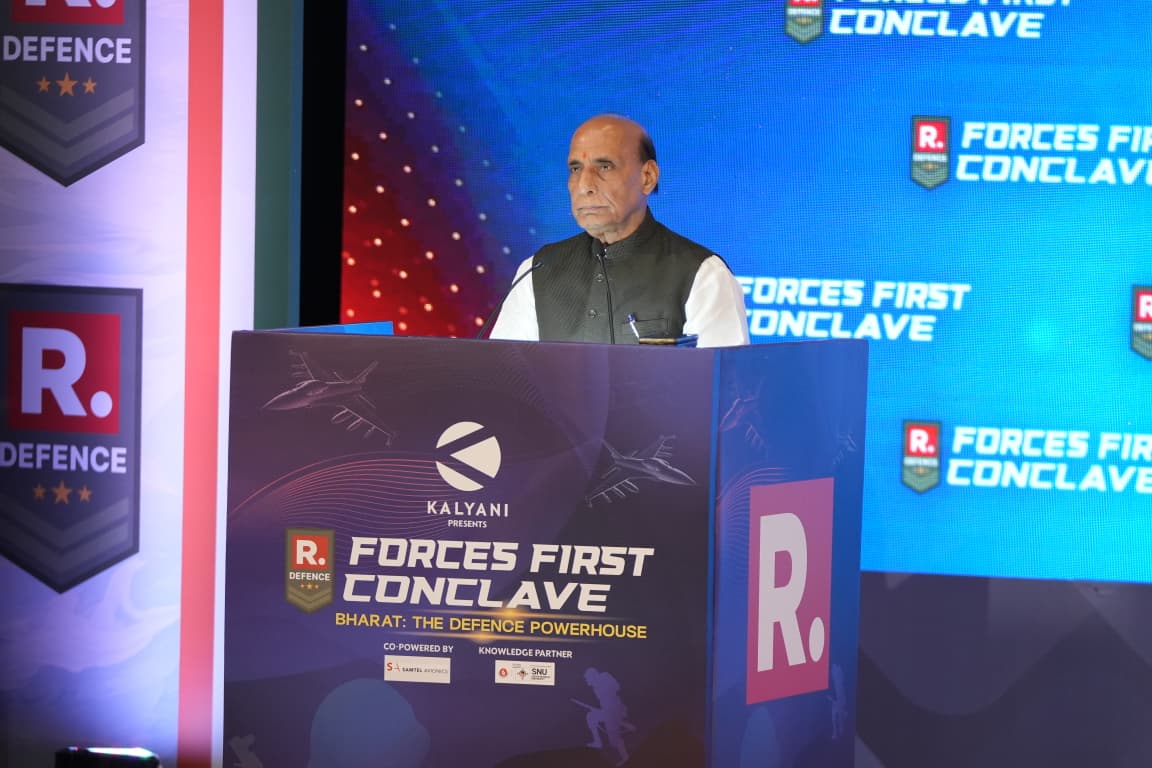
Op Sindoor demonstrated India’s world-class defence readiness sharpened by Govt’s ‘Nation First’ & ‘Forces First’ resolve: Raksha Mantri
“Operation Sindoor is testimony to India’s up-to-date, up-to-the-mark, and up-to-the-standard defence preparedness, sharpened by the transformation of the defence sector through Prime Minister Shri Narendra Modi-led Government’s sustained efforts in the last 12 years, guided by the spirit of ‘Nation First’ and ‘Forces First’,” said Raksha Mantri Shri Rajnath at an event in New Delhi on July 18, 2026. He described Op Sindoor as a reminder of the unmatched valour of the Indian Defence Forces, which gave a befitting reply to terrorists and their patrons, reflecting the Government’s clear ‘zero tolerance’ stance against terrorism. He emphasised that ‘zero tolerance against terrorism’ is not merely a statement but a line of action, reiterating that India has the capability to strike against terrorism not only at its doorstep but also by entering where it resides.
Raksha Mantri asserted that India’s transformed defence sector played a pivotal role in the successful execution of a complex operation such as Op Sindoor, describing it as a shining example of technological warfare and proof of the Government’s trust in Indian industries. “Advanced systems such as Akash Teer, Akash missile system and BrahMos were effectively used during the operation alongside various other state-of-the-art equipment. This is due to the foundation laid over the past 12 years,” he said.
Highlighting the steps taken by the Government to foster Aatmanirbharta in defence, Shri Rajnath Singh stated that five positive indigenisation lists have, so far, been issued by the Defence Forces comprising 509 items, in addition to five by the Defence Public Sector Undertakings consisting of 5,012 items. “As we move forward with determination and a systematic approach towards building a self-reliant and empowered defence sector, another Positive Indigenisation List will soon be notified to further accelerate this vision,” he said.
Listing out the positive results achieved due to the continuous self-reliance efforts, Raksha Mantri said the annual defence production reached a record high of approximately Rs 1.78 lakh crore in Financial Year (FY) 2025-26 from Rs 40,000 crore around 2014. He added that defence exports have crossed an all-time high figure of Rs 38,000 crore from Rs 686 crore in FY 2013-14. “Our defence production target is to surpass the figure of Rs 2 lakh crore this year and Rs 3 lakh crore by 2029. Our goal is to ensure that defence exports reach Rs 50,000 crore by 2029. Given the current pace of progress, I am confident that we will succeed in achieving the targets,” he said.
Shri Rajnath Singh stressed that the Government, in the last 12 years, has changed the “outdated mindset” of preferring imports over domestic manufacturing for the security needs of the country. “Since 2014, it has been our endeavour to strengthen defence preparedness through indigenous production of advanced weapons and technologies, with focus on minimising import dependence. We’ve built a defence industrial ecosystem within the country to fulfill domestic as well as international requirements,” he said.
Raksha Mantri underlined that the Government’s vision of transforming the defence sector is rooted in a firm belief in the nation’s potential and capabilities, in contrast to the approach of the previous government. Describing Aatmanirbharta in defence as the most significant initiative undertaken by the PM Modi-led Government, he stated that India has not only modernised its defence sector but has carried out a major transformation that represents a journey from dependency to self-reliance, and from being a consumer to becoming a producer.
“A nation’s true strength is not measured solely by the size of its military. It depends on its ability to cater to its own needs during times of crisis and providing the soldiers with state-of-the-art weaponry to boost their morale. If a country relies on other nations for weapons, ammunition, navigation systems, missiles, radars, drones, and other warfare-related necessities, its strategic and military autonomy becomes constrained. We’re continuously striving to change this situation,” stated Shri Rajnath Singh.
Elaborating further, Raksha Mantri said the Government has undertaken wide-ranging reforms to strengthen India’s defence innovation and manufacturing ecosystem by simplifying defence exports through initiatives such as the Defence EXIM Portal, online approvals, the Open General Export Licence, streamlined quality certification procedures, the Green Channel policy, and self-certification.
Shri Rajnath Singh underlined that the establishment of defence industrial corridors in Uttar Pradesh and Tamil Nadu is another pathbreaking reform to achieve the goal of self-reliance. He stated that advanced defence manufacturing is being carried out within these corridors, with many companies integrating into global supply chains. “Investments worth approximately Rs 70,000 crore have been proposed for these two defence corridors, with around Rs 10,000 crore already invested. This has created new employment opportunities for the youth. The UP Defence Industrial Corridor, in particular, has emerged as a powerful example of the success of ‘Atmanirbhar Bharat’,” he said.
Enumerating the reforms introduced in defence acquisition, Raksha Mantri highlighted that the steps are aimed at ensuring that Indian industries reap the benefits of defence modernisation. “Seventy-five percent of the budget allocated for defence modernisation has been earmarked for procurement from Indian industries. Under the new Defence Acquisition Procedure (DAP), priority is being given to mechanisms such as ‘Buy Indian-Indigenously Designed, Developed & Manufactured’. This new DAP, to be unveiled this year, will provide fresh momentum to domestic defence production,” he said.
Shri Rajnath Singh stressed that achieving self-reliance requires a robust ecosystem for research, development, and innovation, led by start-ups, MSMEs, and young innovators. Highlighting initiatives such as Innovations for Defence Excellence (iDEX), iDEX Prime, and Acing Development of Innovative Technologies with iDEX (ADITI) scheme, he pointed out that the Government has significantly enhanced financial support for defence innovation. He mentioned that procurement worth over Rs 2,400 crore has been approved from start-ups and MSMEs, and projects worth more than Rs 1,500 crore have been sanctioned for new technologies. “676 start-ups and innovators have been engaging through iDEX, with 551 contracts signed as of March 2026. Today, start-ups across the country are working on drones, artificial intelligence, quantum technology, cybersecurity, robotics, and cutting-edge defence technologies. From only a few dozen start-ups in the defence sector in 2018, the number today has crossed 2,000,” he added.
Raksha Mantri elucidated that the idea of Aatmanirbharta begins with a shift in mindset that transforms policymaking and the system, ultimately impacting the industry. “When the industry transforms, production increases; and when production rises, the nation gains self-confidence. It is a cycle; without setting it in motion, it is impossible to make India’s defence capabilities self-reliant,” he said.
Shri Rajnath Singh said that the corporatisation of the Ordnance Factory Board was aimed at making the factories more technology-friendly in view of the changing times and evolving needs. “The objective was to increase output, and enhance accountability. The decision was taken to bolster national security, while safeguarding the interests of the employees. The results are evident today. These factories have transformed from loss-making entities into profit-making units,” he said.
Raksha Mantri termed India’s youth of today as not merely job seekers, but technological partners in ensuring national security. He highlighted that DRDO has evolved into a national innovation platform connecting industry, academia, startups, and scientists, contributing to a vibrant defence industrial ecosystem comprising DPSUs, private industry, over 17,000 MSMEs, and thousands of supply units across the country.
Shri Rajnath Singh asserted that, today, India is not merely manufacturing defence equipment for itself, it is emerging as a credible global security partner, whose role is extending from the Indian Ocean to the Indo-Pacific. He credited PM Modi’s vision and leadership that have transformed India’s global image.
Referring to PM Modi’s recent visit to Indonesia, Raksha Mantri termed it as a matter of great pride when the President of Indonesia publicly acknowledged the remarkable impact of the welfare schemes rolled out by the Indian Government and expressed his desire to replicate them in his own country. “There was a time when India, in its pursuit of a development model, would attempt to emulate the US, Europe, or Russia. The situation has now changed. Today, India has reached a stage where other nations are following its policies. This marks the beginning of a new era,” he said.
Shri Rajnath Singh added that the Prime Minister’s visit to Indonesia, Australia and New Zealand has elevated India’s diplomatic, economic, strategic, and cultural ties to new heights in the vital Indo-Pacific region, ranging from cooperation on BrahMos Missile System and restoration of the Prambanan Temple in Indonesia to uranium supplies from Australia and the doubling of trade with New Zealand.
Raksha Mantri emphasised that India’s defence diplomacy is no longer confined merely to strategic cooperation; it now encompasses technical cooperation, industrial collaboration, and integration into global supply chains. This transformation, he said, has been driven by Indian scientists, soldiers, engineers, startups, MSMEs, industries, and most of all, the youth of the country.
“This is the India of ‘Amrit Kaal’ which does not shy away from challenges but creates opportunities, which not only ensures its own security but also makes constructive contributions to global peace and stability. When the nation marks the centenary of its independence in 2047, the world will view India not merely as the largest democracy, but also as a highly reliable, modern, and self-reliant defence power,” Shri Rajnath Singh said.
Concluding his address, Raksha Mantri asserted that the Government has resolved to build an Aatmanirbhar and Viksit Bharat, that is both strong and secure. “Our aim is to create a nation where soldiers wield indigenous weapons and technologies, scientists have access to new opportunities, youth possess the power of innovation, and industries have the capacity to compete globally. This is the resolve for New India; this is the path to Viksit Bharat by 2047,” he stated.