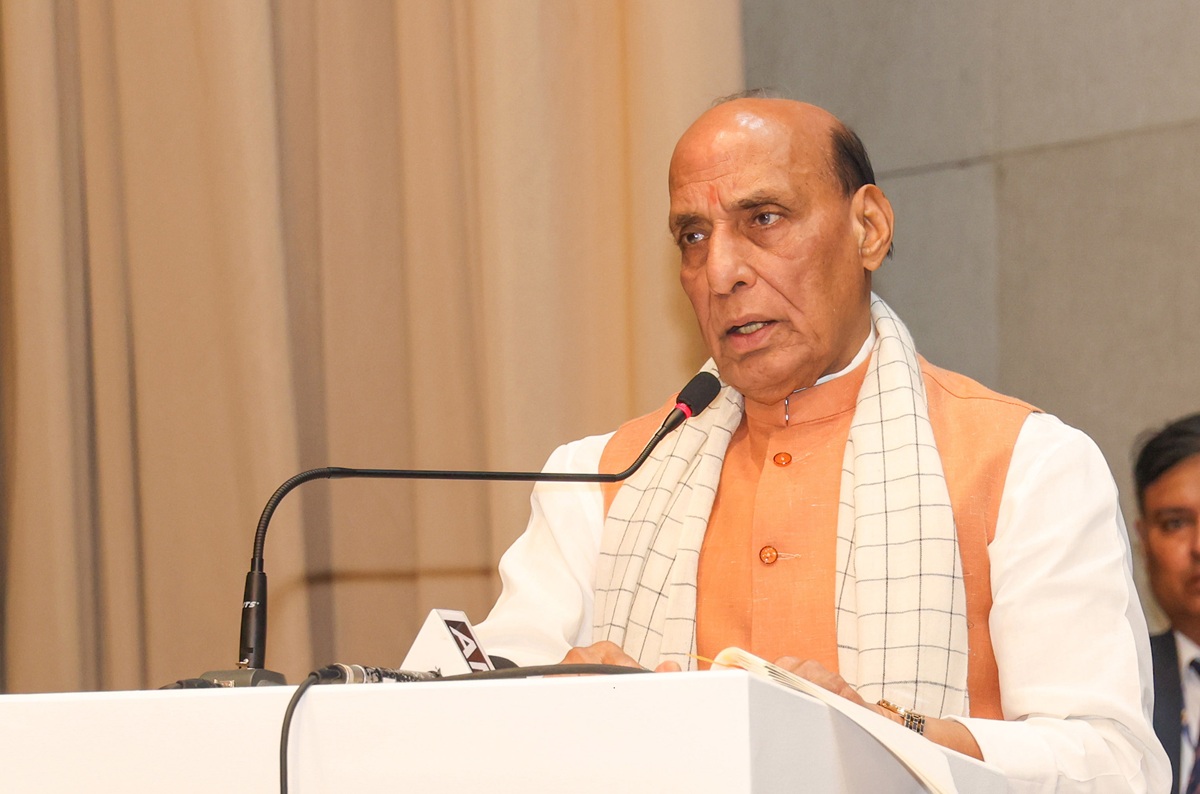
With the participation of 74 nations, MILAN-2026 stands as the largest and most inclusive edition to date: Raksha Mantri
It is a privilege for me to be present in the Opening Ceremony of Exercise MILAN 2026, here at Visakhapatnam — the City of Destiny and indeed, the Jewel of India’s East Coast.
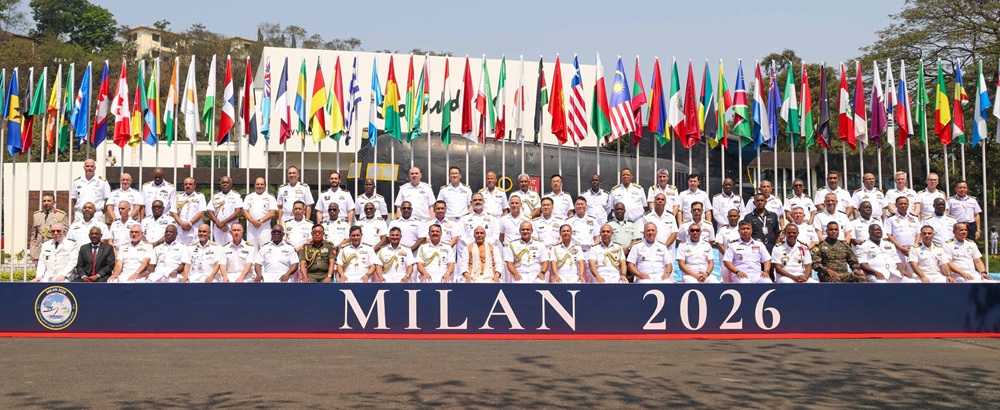
I extend a warm welcome to all the distinguished guests, especially our friends and partners from 74 countries, which is largest participation ever in MILAN. I convey India’s sincere appreciation for your participation in this significant maritime event.
Ladies and gentlemen, yesterday, at the International Fleet Review by the Hon’ble President of India, we witnessed a clear affirmation of goodwill, professionalism and mutual respect among the world’s navies. It was a powerful reminder that while our flags differ, we all speak the same maritime language — a shared commitment to keep the global commons safe, secure and stable.
Ladies and gentlemen, Exercise MILAN gives practical expression to that shared language. Today, we carry forward that cohesive spirit and maritime momentum from ceremony to substance — as we transition decisively into the operational aspect of maritime engagement through MILAN.
Inspired by the Hindi word “milan”, meaning a meeting of friends, this exercise represents, in its truest sense, a meeting of equals and a confluence of like-minded nations and maritime professionals united by a common purpose.
From its modest beginnings in 1995 at Sri Vijaya Puram (then Port Blair), when a small group of friendly navies first came together, MILAN has grown steadily in scope and stature. Over the years, due to concerted efforts of all partners, MILAN has evolved from a regional interaction into one of the world’s most prominent multinational naval exercises. It has evolved into one of India’s most credible and consistent maritime engagements. This year, with the participation of 74 nations, MILAN 2026 stands as the largest and most inclusive edition to date – a reflection of the confidence the global maritime community places in India as a trusted and responsible maritime partner.
MILAN 2026 seeks to enhance interoperability among navies of partner countries, improve professional competence by sharing of professional experiences and practices, and deepen friendships among participating navies by evolving bonds of mutual advantage. Through joint exercises at sea, professional interactions during such meetings, and cultural exchanges, we reaffirm our commitment for establishing a lasting bond of friendship. We aspire to establish an equitable maritime order based on international rules and freedom of navigation in accordance with international law.
Friends, as I address this magnificent gathering of Commanders and senior naval leaders from across the globe, I would like to start by highlighting a few important issues facing contemporary geo-strategic world. It is fashionable these days to say that, as far as international peace and order is concerned, the contemporary technology oriented defence preparedness is moving away from the naval domain.
The increase of naval power has historically been equated with era of mercantilism and colonialism. Growth of capitalism was supported by gun-boat diplomacy of sea-faring nations. And when we analyse the age of colonialism, naval power was the foremost symbol of strength across the world. Nations with formidable and well-equipped navies not only dominated sea trade routes but also extended their influence over distant lands. During that era, Alfred Thayer’s Sea Power Theory gained prominence, wherein he declared: “Who rules the sea, rules the world.”
The equation was no doubt correct in context of 18th-19th centuries power play. The second half of 20th century witnessed an explosion of technology in defence, where lethality and efficiency in warfare enhanced manifold.
This technological revolution led to an erroneous assumption in certain quarters that significance and role of naval power has somewhat reduced strategically.
Friends, it is my firm belief that when almost 75% of surface of our earth is covered with seas and oceans, role of navies can never be downplayed. If at all, the role of navies in international peacemaking has only increased over time and there are good reasons for that.
One, there has been an exponential economic growth during last few decades leading to massive increase in international trade and transport. The busy economic sea channels are arteries of international trade today. As the trade and transport increase, the need for their protection enhances your role.
Secondly, there has been an increase in contests for ownership of straits and channels, sometimes causing threats of flare up. This calls for increased naval watch.
Third, increasing international attention to under-water resources, particularly rare-earth minerals are today adding a new dimension to this tension. The threat to the common good is much more today than ever in history.
Next is the spread of terrorism across the world. There is a need to guard our waters from the nefarious terrorist activities which are spreading tentacles across countries and regions.
Apart from the above, the challenges we face at sea today are much more complex and interconnected. Traditional threats coexist with emerging ones. Piracy, maritime terrorism, illegal fishing, trafficking, cyber vulnerabilities, and disruptions to critical supply chains. Climate change is intensifying natural disasters, making humanitarian and disaster relief operations more frequent and more demanding. No single navy, however capable, can address these challenges alone. This is why cooperation among the Navies is no longer an option, it is an imperative.
It is in the context of these issues that the responsibilities of navies have only increased in recent decades.
Friends, all these distinctive responsibilities call upon the international community to join hands to manage the challenges harmoniously and act in the spirit of mutual respect and give and take. It is here that, I would like to give you an idea to ponder over.
The United Nations Convention on the Law of Seas or UNCLOS, provides a robust legal framework for addressing matters related to the international waters. UNCLOS provides a comprehensive and time-tested mechanism for dispute redressal and peaceful co-existence among nations. It is my belief that this legal framework can be further strengthened through a comprehensive global naval architecture – one that facilitates information sharing, protects links of communications and curbs criminal activities, including terrorism on high seas, along with the usual role of protecting the national boundaries on a global scale.
When I say this, I am also cognizant of the recent erosion of belief in multi-lateralism. Today, we find that the established international order since the end of cold-war is witnessing an upheaval. The stability of last 60-70 years in international order has become uncertain. We are today in search of a more predictable and certain international system of governance.
Platforms like MILAN serve precisely this purpose. They bring together professional expertise, build mutual trust, enhance interoperability, and enable coordinated responses to common challenges. When our ships sail together, when our sailors train together, and when our commanders deliberate together, we build a shared understanding that transcends geography and politics and provides an opportune moment to deliberate on this idea of cooperation.
Friends, India has long recognized the need of this cooperation. Accordingly, our approach to the seas, shaped by Vision of SAGAR — Security and Growth for All in the Region over the last decade, has evolved into Vision MAHASAGAR or Mutual and Holistic Advancement for Security And Growth Across Regions. This evolution from SAGAR meaning seas, to MAHASAGAR or oceans, reflects India’s deepening and expanding commitment to engage with partners in the region and beyond.
India on its part has been a willing partner in all efforts to bring the countries together. We have participated regularly in the multi-lateral engagements and coordinated patrols, our forces have responded swiftly to humanitarian crises from Tsunami to providing timely assistance to our neighbours. We have been engaged in many joint Exclusive Economic Zones surveillance and hydrographic assistance and support missions in times of cyclones.
As a true Vishwa-Mitra or a trusted global friend, we will continue to play a constructive and dependable role in the region. We believe that holistic maritime security and mutual prosperity are indivisible, and can only be achieved through cooperation, trust, and shared commitment among like-minded nations.
I would urge all our friends and partners to make the most of the professional and social engagements scheduled ashore and at sea, to build and renew inter-personal and institutional bonds, while leaving behind a lasting wake of fond memories.
To the officers and sailors of the Indian Navy, particularly those of the Eastern Naval Command, and to the Andhra Pradesh State and Visakhapatnam City administration supporting this event, I commend your unwavering dedication and efforts.
To conclude, I wish MILAN 2026 every success.
Thank You. Jai Hind.