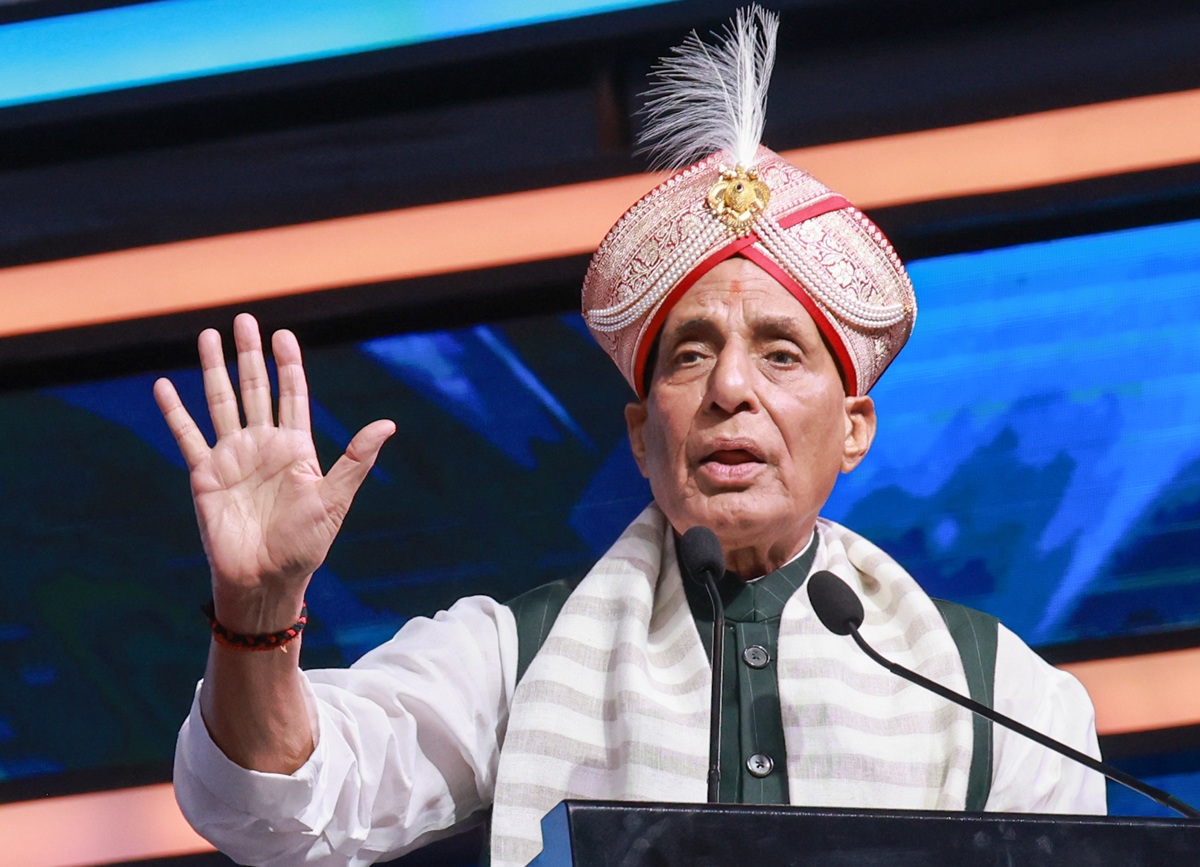
Spirituality gives us the wisdom to live life better: Raksha Mantri
Text of RM’s speech at the Foundation Day celebrations of the BGS & SJB Group in Bengaluru.
Karnataka has been the land of great saints and poets. From the Vachana tradition of Jagadguru Basavanna, Allama Prabhu and Akka Mahadevi Ji to the devotional traditions of Saint Purandara Das Ji and Kanaka Das Ji, this state has made an immense contribution to enriching India’s spiritual consciousness.
It is always a pleasure to visit this land and meet my Kannada brothers and sisters.
However, before I begin my address today, I would like to seek the forgiveness of all my Kannada brothers and sisters present here, as I am unable to speak the great Kannada language.
Friends,
It gives me immense pleasure to be among you all on the occasion of the Foundation Day celebrations of the BGS & SJB Group.
Today’s occasion is special for another reason as well. We are also witnessing the inauguration of the new wing of the state-of-the-art multispecialty BGS Global Institute of Medical Sciences. I am confident that the expansion of this hospital will enable more people to access quality healthcare facilities.
Friends,
Sri Adichunchanagiri Mahasamsthana Math has a rich legacy spanning nearly 1,800 years. For centuries, this Math has served as a beacon of spiritual enlightenment, Indian culture and selfless service to humanity.
Carrying forward this great tradition of service, His Holiness Jagadguru Sri Sri Sri Dr. Balagangadharanatha Mahaswamiji established the Sri Adichunchanagiri Shikshana Trust. Today, the Trust is doing highly commendable work in the field of social service.
I have been told that the Trust runs several hundred educational institutions, where underprivileged students are provided free education and residential facilities. In the field of healthcare, the institution provides free medical checkups, treatment and medicines to those in need. The Math and the Trust also provide free meals to several thousand people every day. Furthermore, the Trust has established a residential school dedicated to the education and development of Divyang children.
All these initiatives are a powerful expression of spirituality translated into service and compassion. True spirituality is not confined to worship or spiritual practice only. It finds its highest expression in working for the welfare of every individual in society. This very spirit is reflected in the work of this institution. These efforts embody the timeless Indian ideal that “Service to humanity is service to God.”
Friends,
The work being undertaken by this institution also carries forward the tradition of ‘Trividha Dasoha’, established by His Holiness Jagadguru Sri Dr. Balagangadharanatha Mahaswamiji. Trividha Dasoha means serving humanity through three fundamental avenues — Anna, Akshara and Arogya, that is, food, education and healthcare.
Mahaswamiji believed that the true worship of God lies in wiping the tears of the weak and the vulnerable, in feeding the hungry, in empowering people through education, and in providing treatment to the sick.
Jagadguru Mahaswamiji also emphasised that we must never leave behind our culture, traditions and values. He promoted modern education, created new opportunities for young people and expanded healthcare services. Yet, throughout these efforts, he ensured that Indian culture, spirituality and the spirit of service to humanity remained at their core.
Today, Jagadguru Nirmalanandanatha Mahaswamiji is carrying forward the vision and resolve of Jagadguru Sri Balagangadharanatha Mahaswamiji with remarkable dedication and commitment. I congratulate him for this. I understand that Jagadguru Nirmalanandanatha Mahaswamiji has received his education from a prestigious institution like IIT. He represents a beautiful confluence of modern knowledge and spiritual wisdom.
Friends,
Today, humanity has gained an understanding of even the smallest subatomic particles. We have reached the deepest depths of the oceans and the farthest frontiers of space. Through Artificial Intelligence, we are now enabling machines to think, learn and make decisions.
Yet, amidst all this remarkable progress, one fundamental question still remains: Is humanity making equal progress in understanding itself? And when we ask this question, it naturally leads us towards spirituality.
The Brihadaranyaka Upanishad expresses this profound idea in one of its verses: “आत्मनो वा अरे दर्शनेन श्रवणेन मत्या विज्ञानेनेदं सर्वं विदितम्।” It conveys that through the realisation and understanding of the Self, one can gain an understanding of the true nature of the entire universe.
I believe that spirituality does not mean turning away from the world. Rather, it inspires us to fulfil our responsibilities while remaining engaged with the world. Spirituality teaches us to exercise control over our thoughts and to keep our human values and sensitivities alive. It also instils in us values such as forgiveness, tolerance, contentment and discipline.
In other words, spirituality does not teach us to escape from life; it gives us the wisdom to live life better and fulfil our responsibilities more meaningfully. Therefore, my message to all the young people present here today is this: If you wish to make your lives not only successful but also meaningful, it is essential that you remain connected with spirituality.
Friends,
Our traditional wisdom has always emphasised on the holistic development of an individual. This includes maintaining good physical health. As the saying goes, “A healthy mind resides in a healthy body.”
Only a healthy citizen can contribute to the development of their family, society and nation to their fullest potential. This is why quality healthcare services play such a vital role in building a developed and prosperous society.
Over the past 12 years, under the leadership of Prime Minister Shri Narendra Modi ji, our government has taken several important steps to strengthen and improve healthcare services. Today, as a result of these efforts, India’s healthcare system has become more accessible, affordable and quality-driven.
Earlier, the cost of medical treatment could force families to sell their homes and belongings. But today, under the Ayushman Bharat Pradhan Mantri Jan Arogya Yojana, free healthcare treatment is being provided to people across the country. So far, more than 48 crore Ayushman cards have been issued, and over 13.25 crore hospital admissions have taken place under the scheme.
To make medicines affordable and accessible to ordinary citizens, more than 18,000 Jan Aushadhi Kendras have been established across the country. Through AMRIT pharmacies, life-saving and essential medicines are being made available at discounts ranging from 50 to 90 per cent. Free dialysis facilities are also being provided in several districts across the country.
Friends,
The quality of healthcare services can improve only when an adequate number of doctors and medical specialists are available. Keeping this in mind, our government has undertaken an unprecedented expansion of medical education in the country.
In 2014, India had only 7 AIIMS institutions. Today, that number has increased to 23. The number of medical colleges has more than doubled, while the number of MBBS and postgraduate medical seats has witnessed an unprecedented increase.
Under the National Programme for Prevention and Control of Non-Communicable Diseases, 770 District NCD Clinics and 524 Day Care Cancer Centres have been established across the country. These centres are expanding access to screening, early detection and treatment facilities for cancer and other serious illnesses.
The healthcare reforms undertaken over the past 12 years have contributed to significant improvements in India’s health indicators. Maternal and child mortality rates have declined considerably, and the number of TB cases has also witnessed a reduction. India has recorded a 78 per cent decline in malaria mortality. Furthermore, in 2024, India successfully eliminated trachoma as a public health problem.
Friends,
The field of medicine is evolving at an unprecedented pace. Artificial Intelligence, Genomics, Automation and Data-driven Healthcare Services are transforming the way diseases are diagnosed and treated. Over the past 12 years, we have laid a strong foundation in these areas, and today, India is steadily moving towards a position of leadership in these emerging fields.
Over the past 12 years, India’s Health Budget has recorded a cumulative growth of more than 194 per cent. Under the Ayushman Bharat Digital Mission, more than 97.5 crore Ayushman Bharat Health Accounts have been created across the country. This means that our healthcare system is becoming more connected, interoperable and citizen-centric.
To make India self-reliant in the field of medical devices, we have launched the Production Linked Incentive (PLI) Scheme. As a result, the manufacturing of several advanced medical devices has now begun within the country.
These include critical medical equipment such as MRI and CT scan machines, LINAC systems, mammography and ultrasound machines, C-arms, heart valves and stents. In 2023, India also developed its first indigenous MRI machine. You may have heard of CAR-T Cell Therapy, an advanced treatment that has shown great results in fighting cancer. India has developed the world’s most affordable CAR-T Cell Therapy. This means that a treatment which was once accessible primarily in a few developed countries and to those who could afford its high cost is now available in India at a much lower price.
All these developments demonstrate that India is not merely adopting modern healthcare technologies; it is also developing them indigenously. Whether it is medical devices or gene and cell therapies, India is moving towards self-reliance across these fields and contributing to shaping the future of global healthcare.
Friends,
India has had a rich and distinguished tradition of medical science since ancient times. Maharishi Charaka is regarded as a pioneer of Ayurveda and medicine, while Maharishi Sushruta is recognised as a pioneer of surgery. And as you all know, Ayurveda is one of India’s invaluable gifts to the world.
Ayurveda is a system of medicine that emphasises holistic health management by maintaining a balance between the mind, body and spirit. In India, we have a rich tradition of Ayurveda and home remedies in almost every family. For instance, many of you may know that ‘Doddapatre’ is traditionally used to relieve coughs and colds. Many of you may also have tasted ‘Shunti-Bellada Kashaya’, a traditional herbal preparation made with dry ginger and jaggery.
However, with the gradual pace of modernisation, some people began to move away from this traditional knowledge or gradually forgot its practices. But today, as the focus is shifting from merely treating diseases to preventing them, people are once again turning towards Ayurveda.
Our government has also taken several important steps to strengthen Ayurveda and other traditional systems of medicine.
These include the establishment of a dedicated Ministry of AYUSH and the ‘All India Institute of Ayurveda’. The WHO Global Centre for Traditional Medicine has also been established in Jamnagar, Gujarat. Today, the entire world celebrates International Yoga Day and is increasingly embracing yoga as a part of its lifestyle.
Friends,
Today, I would also like to share a few thoughts with the medical professionals present here.
You must all have read about the life of Bhagwan Gautama Buddha. Among the four sights that made him realise the impermanent nature of life was the sight of a man suffering from illness. His charioteer, Channa, explained to him that every living being in this world is subject to illness, suffering and death. However, this realisation should not make us pessimistic about life.
Rather, our endeavour should be to constantly find ways to overcome these challenges and fight against them. This becomes possible when you look at your profession not merely as a career, but recognise that you are working for the welfare of humanity and striving to make people’s lives better.
Friends,
There is another important point that I would like you to remember. We are living in the age of Artificial Intelligence. No field remains untouched by it, and healthcare is no exception. However, Artificial Intelligence cannot reassure a mother that her child will recover. It cannot hold the hand of an elderly patient and say, “Do not worry. We will do everything possible to make you better.” Technology may be intelligent, but it cannot be compassionate. It can read medical charts, but it cannot understand the emotional pain of a patient.
Therefore, you must work with empathy and compassion. Always remember that medicine is not merely the science of treatment; it is also the art of providing comfort.
Friends,
There is another important issue to which I would like to draw your attention.
Many of you may also be working in the field of medical research. I have a special request to make. The symptoms of several diseases, their treatment and the effects of medicines can differ between women and men. However, comparatively less research has been conducted on issues related to women’s health. Women’s representation in research studies has also remained limited. I would urge you to undertake more research in this important area so that we can develop a deeper understanding and make the field of medicine more inclusive.
Friends,
I would also like to share a few thoughts with the young people present here today.
Today, we are all working towards realising the dream of a developed and self-reliant India. This can happen only when we are economically and technologically capable while remaining connected to our civilisation and culture. Only when modern knowledge and science are harmoniously integrated with our great civilisational traditions can we build an India that progresses while preserving its unique identity.
Therefore, I urge all of you to embrace modern education, science and technology. Welcome new ideas, but never forget your roots. Learn about your culture, understand your heritage and draw inspiration from it to shape the future.
Friends,
As the Defence Minister of the country, I would also like to share one more thought with you. Our brave soldiers protect the nation while serving at our borders. But national security is not solely the responsibility of our soldiers guarding the frontiers. Every citizen, and young people in particular, can play an important role in strengthening the security of our nation.
I urge all the young people present here to join the National Cadet Corps (NCC). Contribute to national service by exploring opportunities with the Armed Forces Medical Services. You can also strengthen our nation through your knowledge, skills and spirit of innovation.
Friends,
I wish you all a bright and successful future. My best wishes are with this institution as it continues to reach new heights in its commitment to public service and plays an important role in taking the benefits of education and healthcare to the last person in society.
With the hope and prayer that the blessings of Lord Gangadhareshwara and Sri Kalabhairaveshwara remain with us all, I conclude my address.