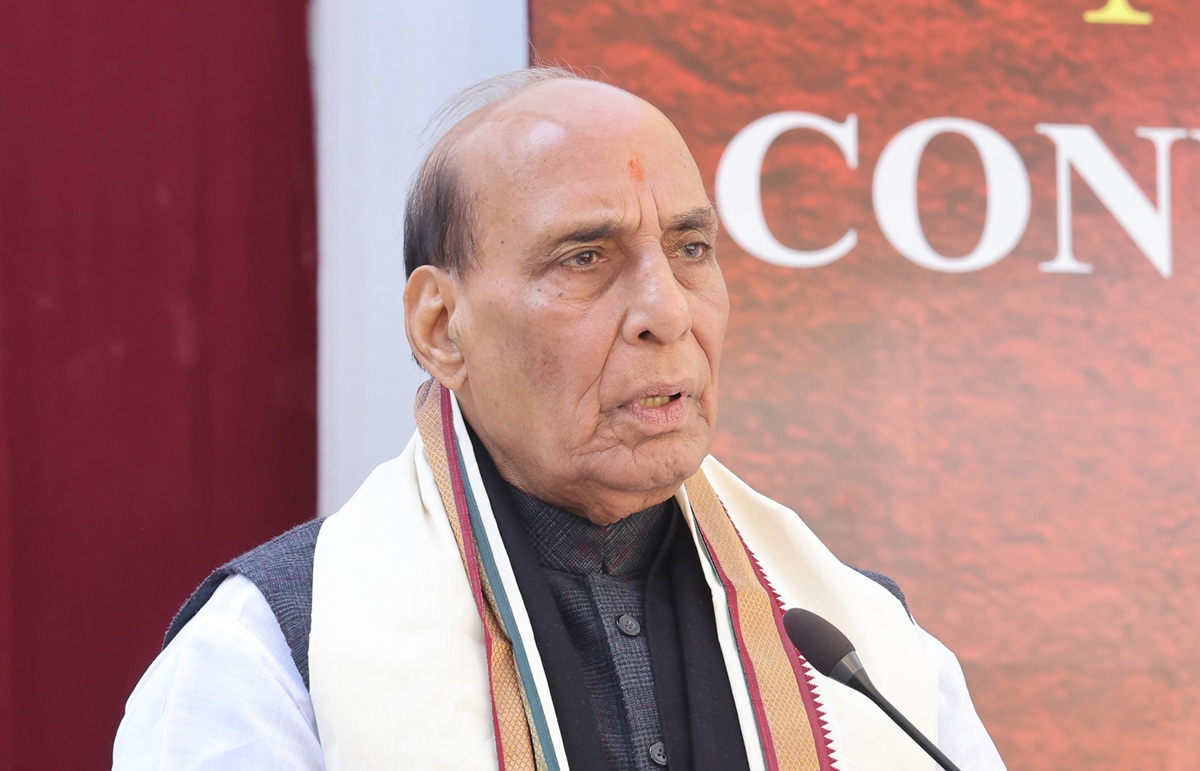
Strategic Leadership Demands Sound Decision-Making: Raksha Mantri
Text of RM’s speech at the Valedictory ceremony of 66th NDC Course in New Delhi.
It gives me immense pleasure to be here today at the National Defence College. At the outset, I extend my heartiest congratulations to all the graduating officers on successfully completing this prestigious course. I also congratulate the Commandant, faculty members and the entire NDC fraternity for their contribution in shaping the future strategic leaders.
Since its establishment in 1960, the National Defence College has evolved into India’s premier institution for strategic learning. Over the decades, it has earned formidable recognition internationally, with its alumni serving in positions of great responsibility in India and several friendly countries. Its greatest strength lies in bringing together senior military officers, civilian officers and international participants on a common platform providing them a unique opportunity to explore not only cross – sectoral complexities, but also international perspectives.
The diversity of experience and perspectives that this institution brings together is particularly valuable in an era when national security challenges increasingly transcend institutional and geographical boundaries.
I am also pleased to note the significant academic transformation undertaken by NDC in recent years. The transition to the Executive MBA in Strategic Leadership and Public Policy, under the aegis of IIT Madras, represents an important step towards enhancing the academic rigour and contemporary relevance of the course. The association with an institution of the stature of IIT Madras has brought valuable expertise in management, science and technology into the study of national security.
I would also like to specially compliment Prof. K. Murali, Dean (Faculty), IIT Madras and his team, which has been closely associated with NDC in running its Executive MBA curriculum at NDC. The recent qualitative increase in eminent speakers’ engagement from IIT Madras with NDC speaks volumes of the close synergy between the two institutions.
I particularly appreciate the introduction of specialised sessions on Artificial Intelligence, Machine Learning, Robotics, Unmanned Autonomous Vehicles, Aerospace Technologies, Semiconductors and other emerging technologies. The introduction of a dedicated AI capsule and the incorporation of closed-loop AI concepts into Strategic Gaming Exercises are also welcome developments.
During my previous visit to this institution in 2024, I had emphasised the importance of academic rigour in preparing future-ready strategic leaders. I had also encouraged NDC to continuously evolve its curriculum, incorporate contemporary security developments and strengthen its engagement with emerging technologies. I am pleased to note that the institution has taken several important steps in this direction.
As we move forward, I believe the next stage of this evolution should be to strengthen the linkage between the knowledge generated at NDC and the actual national security challenges confronting the country. Our endeavour should be not merely to prepare officers who understand strategic challenges, but also to create an institutional environment where their collective experience and intellectual capabilities contribute to addressing those challenges.
The need for such a closer linkage is underscored by the growing complexity and interconnectedness of the national security environment. The global balance of power is evolving, new centres of strategic influence are emerging, and traditional alliances and partnerships are undergoing recalibration. The nature of conflict itself is changing. Conventional military threats increasingly co-exist with cyber-attacks, disinformation, economic coercion, disruption of supply chains and other forms of hybrid warfare. The boundaries between internal and external security, and between peace and conflict, are becoming increasingly blurred.
For India, these developments have particular significance. Our geographical location, extensive land borders, maritime interests and growing international responsibilities place us in a complex strategic environment.
The challenge before us is therefore not merely to respond effectively to immediate threats, but also to anticipate emerging risks, examine alternative scenarios and prepare our institutions for the security environment of the future.
In this context, I would like to draw attention to an important opportunity before the National Defence College. The academic work undertaken at NDC provides an opportunity to harness the collective professional experience and intellectual capabilities of senior officers from the Armed Forces, Civil Services and friendly foreign countries. I believe this intellectual capital can contribute even more directly to India’s national security policymaking.
It may therefore be worthwhile for NDC, in consultation with the Ministry of Defence, to institutionalise a mechanism for identifying a few significant and contemporary national security challenges for intensive examination during every course. These could relate to our strategic neighbourhood, border management, maritime security, critical technologies, economic security, protection of critical infrastructure or the evolving nature of internal and external threats.
At the same time, I would also encourage NDC to institutionalise a mechanism whereby serving senior military officers, senior civil servants and other relevant authorities are invited to formally pose specific contemporary challenges confronting the nation for examination by the course participants. These could be drawn from actual operational, strategic, administrative and policy concerns being faced by different Ministries and organisations. This would bring real-world issues into the academic framework of NDC and provide an opportunity to examine them from multiple perspectives.
More importantly, the research undertaken by course participants should not remain confined to academic papers or classroom discussions. I have been told that NDC already has established mechanisms through thesis research, Agile Strategic Assessment Tasks and Integrated Analysis Group studies. We should explore how these existing mechanisms can be leveraged to generate more direct policy inputs.
Selected studies should culminate in comprehensive reports containing specific, practical and actionable recommendations. These reports should be formally submitted to the Ministry of Defence and other concerned Ministries, wherever relevant. The findings and recommendations should also be presented before appropriate levels of Government for consideration. A mechanism could also be developed for the concerned Ministries to examine these recommendations and communicate their observations.
I would like every course at NDC to leave behind not merely a graduating batch of trained strategic leaders, but also a body of research, analysis and policy recommendations that contributes to the nation’s institutional knowledge and national security preparedness. The intellectual capital generated at NDC should find meaningful expression in our strategic thinking and policymaking processes. Here, dynamic linkage is the key.
Friends, ultimately, the value of strategic knowledge lies in the quality of judgement and decisions it enables. One of the defining tests of strategic leadership is the ability to make sound decisions in conditions of uncertainty, incomplete information, competing priorities and resource constraints. This brings to mind the concept of ‘Bounded Rationality’, propounded by Nobel Laureate Herbert Simon, which many of you may have encountered during your studies at NDC. Simon argued that decision-makers operate within inherent limits of information, time and their capacity to process complex situations. In the real world, particularly in matters of national security, leaders rarely have the luxury of complete information or the ability to examine every possible alternative before taking a decision. They must, therefore, exercise sound judgement, assess the options available and arrive at the most appropriate course of action within the constraints of the situation. The challenge of strategic leadership lies not in waiting for perfect information or ideal circumstances, but in making well-considered decisions while remaining conscious of their wider operational, economic, diplomatic and institutional implications.
Developing this capacity requires more than the study of strategic concepts; it also requires opportunities to test one’s judgement in situations that simulate the complexity and uncertainty of actual decision-making. In this regard, I think the Strategic Gaming Exercises at the National Defence College could have an important role to play. I would encourage NDC to further strengthen these exercises by incorporating emerging technologies, to create more dynamic and realistic scenarios, facilitate the examination of alternative courses of action and enable participants to appreciate the wider and often unforeseen consequences of strategic choices.
Friends, NDC’s contribution to strategic learning and national security understanding is not confined to India alone. I would also like to acknowledge NDC’s important contribution towards strengthening India’s international strategic engagement. The participation of officers from friendly foreign countries in the NDC course is a particularly valuable dimension of this engagement. Studying alongside their Indian counterparts over the duration of the course enables sustained professional interaction, a better appreciation of diverse strategic perspectives and the development of lasting bonds of friendship and mutual trust. These relationships, built through shared learning and experience, become an enduring asset in India’s engagement with partner countries.
In addition, programmes such as the International Strategic Engagement Programme or INSTEP provide focused opportunities for wider international interaction. I am told that recently concluded fourth edition of the two-week INSTEP brought together 25 international participants from 22 countries of the Global South, along with 10 senior Indian officers from the Armed Forces and Civil Services and three officers from defence companies. Such initiatives further strengthen the exchange of ideas and experiences among countries facing common and evolving strategic challenges.
An increasingly inter-connected world, requires greater international cooperation. India believes in a collaborative approach to addressing such challenges, based on respect for sovereignty, mutual trust and shared responsibilities. The professional relationships and friendships developed at NDC should continue well beyond the completion of the course. The institution’s international alumni network represents a valuable reservoir of experience and strategic understanding that can contribute to stronger bilateral relationships and international cooperation.
Friends, as you return to your respective assignments, I would urge you to carry forward the spirit of intellectual curiosity, professional engagement and institutional collaboration that you have developed during your time at NDC. The real value of this course will ultimately be reflected in how you apply its learnings in your respective organisations. You must aspire not merely to become better-informed leaders within your institutions, but also to become bridges between organisations, catalysts for reform and contributors to the evolution of India’s national security architecture.
For our international participants, I hope the friendships and professional relationships developed during this course will continue to strengthen mutual understanding and cooperation between our countries. You will remain important bridges between India and your respective nations.
Friends, before I conclude, I would like to reiterate that the strength of a nation lies not merely in its military capabilities or economic resources, but also in the quality of its institutions, the foresight of its leadership and its ability to adapt to a changing world. India’s aspiration to emerge as a developed nation and a leading global power must be underpinned by a strong, resilient and technologically advanced national security architecture. Institutions like the National Defence College have an important responsibility in shaping the leadership and strategic thinking that will support this journey.
I would encourage NDC to continue evolving as an institution that not only imparts knowledge but also generates ideas, facilitates informed debate, develops policy perspectives and contributes meaningfully to national security decision-making.
Once again, I congratulate all the graduating officers and wish them every success in their future endeavours. May the National Defence College continue to grow in strength and stature and make an even greater contribution to India’s national security and international strategic engagement.
Thank you.
Jai Hind!