Nation’s security, strategic autonomy & sovereignty are inextricably linked to food security: Raksha Mantri
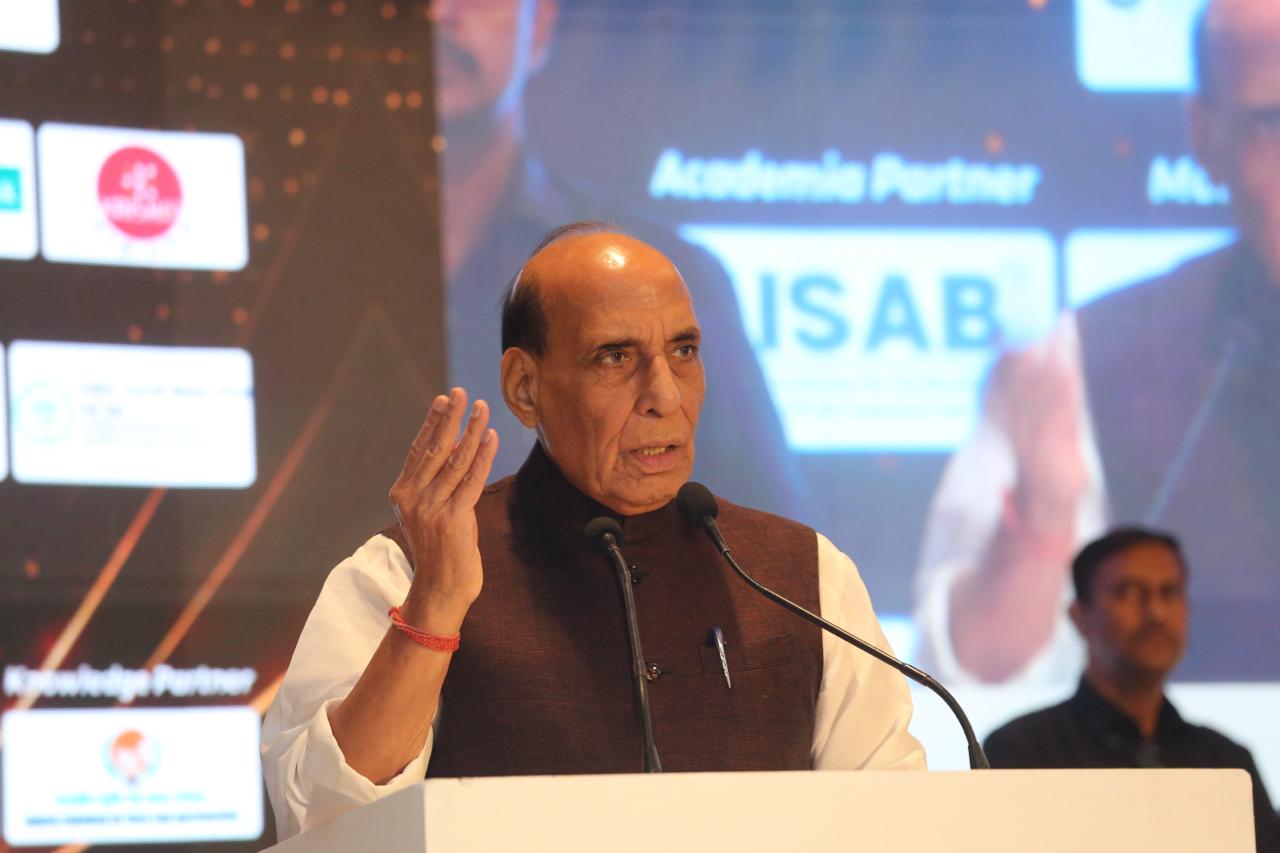
“The nation’s security, strategic autonomy, and sovereignty are inextricably linked to food security,” said Raksha Mantri Shri Rajnath Singh as he outlined the unprecedented transformation of India’s agricultural sector and empowerment of farmers under the leadership of Prime Minister Shri Narendra Modi over the last 12 years. He was addressing the Agriculture Leadership Conclave and Awards 2026 in New Delhi on July 08, 2026.
Raksha Mantri stated that post-independence, India witnessed a phase where it was dependent on other countries for food grains, a “humiliating situation” which has completely changed due to the Government’s efforts to empower the farmers and the agricultural sector over the past 12 years. “The budget for the Department of Agriculture and Farmers’ Welfare has increased nearly fivefold. Our food grain production has risen by approximately 93 million tonnes. We once imported food grains; today we’re exporting them to numerous countries. India has also emerged as a global leader in the production of fruits, vegetables, milk, and honey. Many Indian products are making their mark in international markets for the first time. A soldier and a farmer are performing the same task – safeguarding the nation and its self-respect,” he said.
Recalling his time as the Agriculture Minister in the Atal Bihari Vajpayee-led government in 2003, Shri Rajnath Singh stated that he accorded the highest priority to the interests of farmers during the tenure. “At that time, interest rates on agricultural loans were halved. A Farmers’ Commission was established to address the issues faced by farmers. Initiatives such as the Farm Income Insurance Scheme and the Kisan Call Centre were also launched,” he said.
Voicing the Government’s resolve to increase the farmers’ income, Raksha Mantri stated that the long-pending Swaminathan Committee recommendation of ‘providing farmers an MSP of at least one-and-a-half times their cost of production’ was implemented, which the UPA government never paid heed to during their tenure. He added that approximately Rs 4.5 lakh crore has, so far, been distributed to farmers through the Pradhan Mantri Kisan Samman Nidhi. “Farmers have been provided a safety net through the PM Fasal Bima Yojana. Under this scheme, farmers have received nearly Rs 2 lakh crore during times of crisis,” he stated.
Shri Rajnath Singh further stated that during the UPA government’s tenure, only five crore farmers benefited from Kisan Credit Cards, but today, the number has increased to approximately 12 crore. “In the 10 years of the UPA government, agricultural loans worth Rs 7 lakh crore were provided to farmers, whereas our government has disbursed Rs 28 lakh crore. Between 2004 and 2014, a fertiliser subsidy of Rs 5 lakh crore was provided, but since 2014, we have given subsidies exceeding Rs 13 lakh crore. Fertiliser prices have risen sharply in the international market, yet our government has not allowed that burden to fall on our farmers,” he said.
Raksha Mantri added that over the last 12 years, over 10,000 Farmer Producer Organisations have been formed, 26 crore Soil Health Cards distributed, and six new modern urea plants established. “The world today praises the work carried out by PM Modi for our agriculture and farmers. The Food and Agriculture Organisation honoured him with the Agricola Medal, which is a matter of pride for the entire nation,” he said.
Enumerating the steps taken by the Government to empower the farmers with modern science and technology, Shri Rajnath Singh stated that research and development activities related to agriculture have been accelerated. He added that the world’s first nano-fertiliser has been produced in India, while farmer IDs have been created for crores of farmers, and digital surveys conducted of crores of farms. “To ensure farmers receive the right information at the right time, the National Pest Surveillance System has been launched. Campaigns like ‘Per Drop More Crop’ are promoting micro-irrigation and precision farming. The ‘Bharat-VISTAAR’ platform has been launched to promote the use of AI in agriculture, delivering information to farmers in their own language. Through ‘Drone Didi Yojana’, women are being trained to use drones in agricultural activities, thus providing a new impetus to the national economy,” he stated.
Raksha Mantri underlined that the Government’s resolve is not merely to develop agriculture but to make it state-of-the-art and profitable, while making farmers self-reliant. He stressed that Indian farmers are giving a new direction to agriculture through their experience, traditional knowledge, and new experiments.
“An Indian farmer is not just Annadata, but also Gyandata,” said Shri Rajnath Singh while citing various inspiring examples of Indian farmers remaining rooted in their traditions while embracing innovation in sync with changing times. The examples include Smt Rahibai Soma Popere from Maharashtra who spearheaded a campaign to conserve indigenous seeds; Shri Raghupat Singh from Uttar Pradesh who made significant contributions to the conservation of traditional seeds; Smt Rajkumari, known as Kisan Chachi from Bihar, who transformed farming into a vehicle for women empowerment and self-employment; Shri Shrirang Devba Lad from Maharashtra who developed new techniques for cotton cultivation; and Smt Kumari Sabarmati from Odisha for setting an inspiring example in organic farming and biodiversity conservation.
Raksha Mantri called for bringing the best agricultural practices of the farmers to the forefront on a large scale for others to draw inspiration. He stated that the confluence of tradition and technology has the potential to become the greatest strength of Indian agriculture.
Shri Rajnath Singh highlighted that following the ‘Green Revolution’, Indian agriculture is undergoing its most significant transformation, as it is no longer merely a means of livelihood, but is evolving into a hub for entrepreneurship and investment. “Agri-startups, organic farming, food processing, agri-logistics, and agri-exports are creating new opportunities and possibilities within the agricultural sector,” he said while urging the youth to strive and build a modern yet self-reliant, smart yet nature-friendly and sustainable agricultural system.
While Raksha Mantri credited the farmers for helping the nation set numerous records in agricultural production, he exhorted them to continue working with the mantra of ‘Produce More’ while embracing ‘Produce Better,’ ‘Produce Greener,’ ‘Produce Smarter,’ and ‘Produce Healthier’. “With this vision in mind, PM Modi has called for reducing dependence on chemical fertilisers and adopting organic farming. This will not only lower farming costs but also enhance soil fertility. Crop quality will improve, farmers’ incomes will increase, while aiding in achieving Sustainable Development Goals,” he said.
Shri Rajnath Singh emphasised that while India ranks number one in the world in terms of the number of organic farmers, there is a need to move forward with the vision of “Evergreen Revolution”. “We must build an agricultural system that is profitable to farmers, friendly to the environment, and secure for future generations. This will mark the next golden chapter in the agricultural journey of Viksit Bharat,” he said.